Search “gut health quiz” and you’ll land on a two-minute assessment that spits out a score, a personality-coded bacteria profile, and a supplement bundle at checkout. None of that is a diagnosis. It’s marketing wearing a lab coat.
Here’s the less satisfying, more useful truth: gut health isn’t a single number, and researchers who study the microbiome for a living still don’t agree on what a “healthy” one even looks like — some have gone as far as arguing that a universally healthy microbiome might not exist at all (PNAS, 2023). What you actually have access to, sitting at home without a lab, is a pattern of symptoms and a set of questions your doctor can answer with real tests if things don’t add up. That’s a lot less exciting than a personalized bacterial report card. It also happens to be true.

There’s no blood test that stamps a verdict on your gut. What you actually have is a cluster of clues — bloating that’s become your daily baseline, bowel habits that shifted and stayed shifted, skin flare-ups, energy crashes, and cravings that feel more compulsive than seasonal — and the strength of the case depends on how many show up together and how long they’ve stuck around. A single gassy evening after burrito night doesn’t count. Weeks of a consistent pattern, especially alongside red flags like blood in your stool or unexplained weight loss, is when this stops being a wellness question and starts being a doctor’s-office question.
Medical Disclaimer: Quick note before we get into it — I’m a researcher and writer, not a doctor, and nothing below is a diagnosis or a treatment plan. Gut symptoms overlap with a long list of conditions, some minor and some that need real medical attention, and only a clinician looking at your actual history and labs can sort out which is which. If any of this sounds like what you’re dealing with, especially if it’s persistent or getting worse, take it to a doctor or registered dietitian instead of self-treating off an article.
The Short, Honest Answer
You don’t “know” your gut health is bad from one symptom. You get suspicious when several show up together and refuse to go away: bloating that’s now just part of your day instead of an occasional thing, bowel habits that have changed and stayed changed, fatigue that doesn’t track with how much you slept, skin that’s flaring for no obvious reason, and sugar cravings that feel less like preference and more like a demand.
But the longer version matters more. It involves knowing which symptoms are genuinely gut-related, which ones get blamed on “gut health” mostly because it’s trendy right now, and which ones are your body waving a flag that has nothing to do with bacteria — a stomach ulcer, a thyroid problem, celiac disease, or something that needs imaging rather than a smoothie. That distinction is the entire point of this article, and it’s the part most “10 signs of bad gut health” listicles skip.
What “Gut Health” Actually Refers To
Your gut hosts somewhere around 38 trillion bacteria, roughly matching or outnumbering your own cells depending on which estimate you use (Henry Ford Health, 2026). That community — plus fungi, viruses, and archaea — does more than digest your lunch. It ferments fiber into short-chain fatty acids that feed your colon cells, trains and regulates a huge chunk of your immune system, helps synthesize certain vitamins, and talks directly to your brain through the vagus nerve and a rotating cast of signaling molecules.

That last part — the gut-brain axis — is real and increasingly well-documented, not wellness-influencer poetry. Jun Huh, an immunology researcher at Harvard Medical School, describes it plainly: the gut and brain are “constantly talking to each other,” and when that communication breaks down it can show up as anxiety, irritability, or a low mood that doesn’t have an obvious trigger (Harvard Health, 2026). A 2023 study in Psychological Medicine, involving over 200 women’s stool samples and mood questionnaires, linked specific gut microbes to feelings of happiness and hopefulness — an association, worth saying clearly, not proof that a particular bacterium causes a particular mood.
“Dysbiosis” is the term researchers use for an imbalanced gut community — usually described as reduced microbial diversity, fewer beneficial microbes, or an overgrowth of less helpful ones (MedComm, 2025). It sounds precise. It isn’t, and that’s worth sitting with before you go any further.
Two mechanisms are worth understanding because almost every symptom in this article traces back to one of them. The first is short-chain fatty acid production. When gut bacteria ferment fiber, they produce compounds like butyrate, which is the primary fuel source for the cells lining your colon and plays a role in keeping that lining intact. Less fiber reaching the colon generally means less of this fermentation, which is part of why low-fiber diets are consistently linked to worse markers of gut barrier integrity and inflammation, even when the effect on microbial diversity itself is inconsistent (journal review, 2025).
The second is immune training. A large share of your immune system sits in gut-associated tissue, in near-constant contact with whatever’s living in your intestines. That’s not incidental — it’s how your body learns to tell harmless food particles and resident bacteria apart from actual threats. When that system gets chronically triggered, the downstream inflammation doesn’t necessarily stay local. It’s one of the more plausible mechanisms connecting gut symptoms to things that feel completely unrelated, like skin flare-ups or joint aches, even though the direct evidence linking specific skin conditions to specific gut states is still thinner than the confident claims floating around wellness content would suggest.
The Complication: “Dysbiosis” Is a Messier Idea Than It Sounds
Here’s what most gut health content won’t tell you, because it undercuts the sales pitch: scientists studying the microbiome have not been able to identify a set of “core” bacterial species that everyone with a healthy gut shares. A 2023 paper in PNAS put it bluntly — the inability to define a consistent healthy baseline “challenges the idea that gut dysbiosis can be defined based on changes in species composition” at all, and some researchers argue the term dysbiosis has become more of a distraction than a useful diagnostic concept (PNAS, 2023).
That doesn’t mean dysbiosis is fake. It means the science is genuinely unsettled about how to define, measure, and diagnose it in an individual person — which is a very different claim than “your gut bacteria are broken and here’s the $80 fix.” Add to that the sheer variability between people: large-scale studies looking for microbiome-disease links have found so much individual variation that results from any single small study are often unreliable on their own (Scientific Reports, 2019 — Note: 2019 study, verify current consensus on republish).

There’s a related habit worth flagging: a lot of consumer content treats specific bacterial ratios — most commonly the Firmicutes-to-Bacteroidetes ratio — as a simple health score, higher or lower being “better.” That ratio was popularized by early obesity research and picked up by testing companies because it’s easy to put on a slide. It has not held up as a reliable, universal marker across the broader body of research that followed, and plenty of researchers now treat it as one data point among many rather than a verdict. If a test result leads with that ratio as the headline finding, that’s a reasonable moment to lower your confidence in the rest of the report.
Fiber is the clearest example of how messy this gets in practice. A meta-analysis of 64 randomized trials in over 2,000 healthy adults found that fiber interventions reliably increased beneficial bacteria like Bifidobacterium and Lactobacillus (ScienceDirect meta-analysis, 2018 — Note: 2018 study, verify current consensus on republish). Good news for the “eat more fiber” advice you’ll see below. But a large 2025 randomized trial of over 800 people with prediabetes found that a dietary fiber intervention produced no statistically significant improvement in blood sugar markers compared to standard care, despite the biological plausibility (Nature Communications, 2025). Moving your gut bacteria in the “right” direction and moving your actual health outcomes are not automatically the same thing. That gap is where a lot of gut health marketing quietly stops looking.
Signs Worth Paying Attention To — And What They Might Mean
None of these symptoms are exclusively about gut health. Almost all of them overlap with a dozen other conditions. That’s exactly why a symptom checklist alone can’t diagnose anything — but a pattern, tracked over weeks, is genuinely informative.
Start with bowel movement frequency, since it’s the most concrete data point you already have without buying anything. The commonly cited clinical range runs from three times a day to three times a week — both ends of that are considered within normal variation, which surprises people who assume “once a day” is some kind of biological requirement. What matters more than the count is form and effort: stool that’s consistently hard, consistently loose, or that requires straining or urgency on a regular basis is more informative than the number on its own.
| Symptom | Usually Nothing Alarming | Becomes a Red Flag When… |
|---|---|---|
| Bloating / gas | Occasional, tied to specific foods (beans, dairy, artificial sweeteners) | Daily, rapidly worsening, or paired with weight loss |
| Bowel habit changes | Short-term shifts from travel, stress, or a new diet | Persists 3+ months, alternates diarrhea/constipation, or starts after age 50 |
| Fatigue | Explained by poor sleep or a demanding week | Persistent despite adequate sleep, especially with pale skin (possible anemia) |
| Skin flare-ups (acne, eczema) | Hormonal or seasonal patterns | New-onset, widespread, unresponsive to usual skincare |
| Blood in stool | Rarely nothing — always worth mentioning to a doctor | Any occurrence, especially dark/tarry stool |
| Unintentional weight loss | Almost never benign on its own | Any amount without trying, especially with other symptoms |
| Nighttime symptoms | Uncommon in typical IBS | Waking from sleep due to pain or urgent bowel needs |
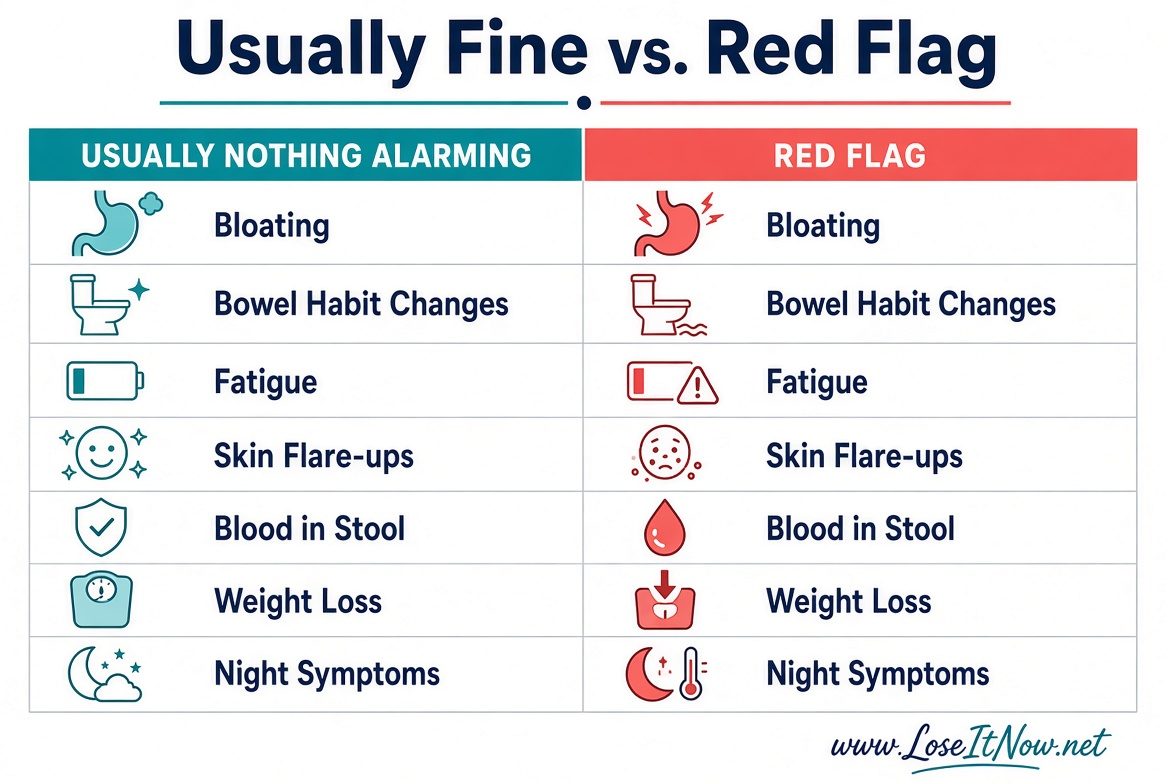
Clinicians who study gastrointestinal disease keep repeating a version of the same warning: symptoms overlap enormously between conditions, and the specific red flags — blood in the stool, unexplained weight loss, and inflammation markers on bloodwork — are what actually separate “probably fine, adjust your diet” from “get evaluated now” (NIH News in Health, 2024). New digestive symptoms that show up for the first time after age 50, or that wake you up at night, get you evaluated faster too — that’s not typical of run-of-the-mill IBS.
Two symptoms deserve a slightly longer explanation because they get thrown around loosely: sugar cravings and skin flare-ups. Neither is a clean, proven “gut health” symptom the way blood in your stool is a clean red flag — but both have a plausible mechanism behind them, which is a different and weaker claim than a proven one. The craving story goes like this — certain bacterial populations ferment simple sugars more efficiently than complex fiber, and some researchers hypothesize that a gut community skewed toward those bacteria may reinforce cravings for the foods that feed them, creating a loop. It’s a genuinely interesting hypothesis. It is not the same as a demonstrated cause, and I’d be cautious of anyone who tells you otherwise with total confidence.
Skin is similar. Acne, eczema, and rosacea have all been associated with gut inflammation and, in some smaller studies, with specific microbial patterns. The proposed mechanism runs through the immune-training pathway described earlier — inflammatory signals that start in the gut showing up as inflammation elsewhere, skin included. Associated is the operative word. It’s a real research thread, not settled science, and it’s nowhere near strong enough to justify skipping a dermatologist in favor of a gut protocol if your skin issue is significant.
The Thing Nobody Talks About: Your At-Home Gut Test Probably Isn’t Telling You What You Think
Every “how do I know my gut health is bad” article eventually points you toward a $99–$300 mail-in stool kit. Fewer of them mention what happens when you send the same stool sample to seven different testing companies.
Researchers actually did this. Seven at-home microbiome tests, one sample, dramatically different results — different bacteria flagged as dominant, different “diversity scores,” different recommendations (Scientific American, 2026). The study’s co-author, a health law professor, didn’t mince words: gut health has been sold to the public as something you can fix through diet and lifestyle tweaks based on your personal microbial report, and “the hype doesn’t really match the evidence.”

The National Institute of Standards and Technology ran its own comparison and found the same problem, for a genuinely mundane reason: there’s no agreed-upon “normal” gut microbiome to measure yourself against, and the testing process itself — how the sample is handled, what gets sequenced, which reference database gets used — introduces its own bias before your results even reach an interpretation algorithm (NIST, 2026). As of this writing, no microbiome diagnostic test has FDA approval for clinical use in the U.S. — the entire direct-to-consumer category sits in a regulatory gray zone between “medical test” and “wellness product.”
A gastroenterology team at Henry Ford Health summed it up about as directly as a hospital system ever does: “there aren’t tests that are clinically proven or detailed enough to inform the way we manage an individual’s health” (Henry Ford Health, 2026). That’s not a knock on curiosity — it’s a reason to treat a consumer diversity score as trivia, not a diagnosis, and to spend the money on a doctor’s visit instead if something’s actually wrong.
Part of the problem is mundane and rarely mentioned in the marketing: a stool sample only captures what’s passing through at that moment, not your whole gut ecosystem, and it can shift meaningfully based on what you ate the day before, your stress level, or even how the sample sat before it reached the lab. Stack that on top of no standardized reference range and different sequencing methods between companies, and it stops being surprising that seven labs looked at identical material and came back with seven different stories. None of that makes the underlying science fake. It makes a single consumer test a genuinely poor tool for deciding whether your gut health is “bad.”
What Actually Helps — Practical, Boring, and Evidence-Based
None of this is going to make a good ad. It’s still what the evidence supports.
- Track your symptoms for two to three weeks before you decide anything is “chronic.” Note what you ate, stress levels, sleep, and bowel habits day by day. Patterns matter more than any single bad day.
- Increase fiber gradually, not all at once — a sudden jump from 15g to 40g a day is a fast way to create the exact bloating you’re trying to fix.
- Add variety, not just volume. Diverse plant foods — legumes, whole grains, different vegetables week to week rather than the same three on rotation — appear to matter more for microbial diversity than simply eating more of one “gut healthy” food every day. Thirty different plant foods a week sounds like a lot until you count spices, herbs, and coffee toward the tally.
- Cut back on ultra-processed food where you reasonably can. This is unglamorous advice that shows up again and again in nutritional psychiatry and gut-brain research alike, and it doesn’t require a full elimination diet to be worth doing — swapping a few processed staples a week for whole-food versions is a realistic starting point, not an all-or-nothing project.
- Sleep and stress management are not “extra” gut health tips tacked onto the real advice — they’re part of the same system. The vagus nerve runs in both directions, and chronic stress and poor sleep have both been shown to reduce microbial diversity over time, independent of what you’re eating.
- If bloating is a recurring, specific problem rather than a general “I feel off” — especially with pain that improves after a bowel movement — ask a doctor about IBS and whether a structured elimination approach like low-FODMAP makes sense for you, ideally with a dietitian’s guidance rather than solo.
- Skip the $200 stool test as a starting point. If you want objective data, ask your doctor about targeted tests — a fecal calprotectin test for inflammation, standard bloodwork for anemia or celiac markers — which actually have clinical validation behind them.

And see a doctor promptly — not eventually, promptly — if you notice blood in your stool, unintentional weight loss, fever alongside digestive symptoms, symptoms that wake you at night, or new digestive changes after age 50. Those aren’t “maybe adjust your yogurt intake” symptoms. They’re “get evaluated” symptoms, full stop.

Do Probiotics Actually Fix a Bad Gut?
Probably not the universal reset the label implies. The most rigorous recent look at this question comes from a 2024 expert panel review published in Advances in Nutrition, which applied the same evidence standard the U.S. Preventive Services Task Force uses for population-wide health recommendations (Advances in Nutrition, 2024). Their conclusion was genuinely nuanced, not a blanket yes or no.
For specific situations, the evidence held up: certain probiotic strains meaningfully support gut function during antibiotic courses, and some reduce the risk of respiratory tract infections. A separate meta-analysis of good-quality trials found probiotics shortened the duration of common respiratory illnesses by close to a day on average. That’s real, replicated, useful.
For the broader promise — take this capsule, generally improve your gut, generally feel better — the same review found the evidence too thin to support a population-wide recommendation. Strains vary. Doses vary. Study quality varies enormously. And a probiotic that measurably shifts your stool bacteria for a few weeks isn’t automatically the same thing as a probiotic that fixes whatever’s actually bothering you. If you’re already generally healthy and taking a daily probiotic because it feels responsible, current evidence says it’s very unlikely to be harmful and might help around the edges. It is not a substitute for figuring out what’s actually driving persistent symptoms.
What’s Missing From the Research (Even the Good Research)
Worth being honest about the gaps here, since most of this article leans on genuine science and genuine science has limits.
Most human microbiome research is associational — it shows that certain bacteria show up more often alongside certain conditions, not that the bacteria caused them. Untangling cause from effect in a living gut, where diet, medication, stress, sleep, and genetics are all moving at once, is genuinely hard, and most individual studies are too small to fully account for it. A lot of the field’s biggest, more mechanistic claims — including plenty around “leaky gut” — come from animal studies that haven’t been confirmed the same way in humans yet.
Population diversity is another blind spot. Most of the foundational microbiome research was done on relatively narrow slices of the population — largely urban, largely Western, largely a specific age range — even though the same research shows that geography, industrialization, and lifestyle substantially shift baseline microbial diversity between populations (Frontiers in Microbiology, 2025). Rural, non-industrialized populations tend to carry meaningfully higher microbial diversity than urban ones. What that means for any individual reading a “normal range” on a test built from a narrower reference population is genuinely unclear, and it’s rarely disclosed anywhere near the results page.
And a smaller, more mundane point that still matters: a lot of “gut health” content quietly assumes the reader has ruled out other explanations first. Fatigue, mood changes, and digestive symptoms overlap with thyroid conditions, iron deficiency, and a long list of other things that have nothing to do with your microbiome. Chasing a gut fix for a non-gut problem doesn’t just waste money — it delays the actual diagnosis.

Increased intestinal permeability — the biological phenomenon behind “leaky gut” — is measurable and real in specific, well-documented conditions like celiac disease and inflammatory bowel disease. But “leaky gut syndrome” as a standalone, catch-all diagnosis explaining fatigue, brain fog, skin issues, and mood problems all at once isn’t recognized as a medical diagnosis, according to the Cleveland Clinic, precisely because there’s no standard, validated test for it and no strong evidence it functions as an independent disease rather than a downstream feature of other conditions (Cleveland Clinic, 2026). The underlying science is legitimate. The marketing built on top of it has usually outrun what that science actually says.

My Take
This is where I’ll say something that isn’t strictly a citation: the internet has turned “gut health” into a diagnosis-shaped hole, and an entire industry exists to fill it with something purchasable. That’s not a conspiracy theory — it’s just what happens when genuinely interesting, genuinely unfinished science (the microbiome is one of the more exciting areas of medicine right now) meets a public that wants a clean answer and a company that’s happy to sell one.
What actually seems to move the needle, based on the research that exists, is almost aggressively unglamorous: eat more plants, more fiber, more variety; sleep enough; manage stress in whatever way actually works for you; and stop trying to diagnose yourself from a chart of bacterial percentages a company built its business model around selling you. I’ll admit that’s a less satisfying answer than “here’s your exact gut type.” It’s also the one that doesn’t fall apart the moment you look at the underlying studies.
If your symptoms are mild and mostly annoying, the boring stuff genuinely is the move. If they’re persistent, severe, or paired with any of the red flags in the table above — that’s not a gut health question anymore. That’s a doctor’s appointment.
One more thing I’ll say plainly, since it’s easy to miss in an article this long: skepticism about the testing industry and the supplement marketing around gut health isn’t skepticism about the microbiome itself. It’s one of the more genuinely promising areas of medicine right now, with real researchers doing careful, incremental work. The gap between that careful work and what shows up in your Instagram feed is enormous, and closing that gap — not dismissing the science, not buying every product built on top of it — is really what this whole article has been trying to do.
Frequently Asked Questions
How do I know if my gut health is bad?
Short answer — you look for a pattern, not a single bad day. Persistent bloating, bowel habits that have changed and stayed changed for weeks, unexplained fatigue, skin flare-ups, and strong sugar cravings, especially when several show up together, are the cluster worth paying attention to. One gassy afternoon after a big meal isn’t a gut health crisis; three months of daily symptoms is worth tracking and possibly discussing with a doctor.
What are the first signs of an unhealthy gut?
Digestive symptoms tend to show up first and most obviously — bloating, gas, irregular bowel movements, and heartburn. Less obviously connected signs, like fatigue, skin breakouts, and low mood, tend to follow or run alongside the digestive symptoms rather than appearing completely on their own. If you’re trying to catch things early, the digestive symptoms are the more reliable early signal to track, precisely because the “less obvious” ones have so many other possible causes that they’re hard to pin on your gut with any confidence in isolation.
Can bad gut health cause anxiety or brain fog?
The word “cause” is doing a lot of work in that question. Gut and brain communicate constantly through the vagus nerve and gut-produced signaling molecules, and disrupted gut function is associated with anxiety, irritability, and low mood in a meaningful body of research. That’s a real, replicated association — it isn’t the same as proof that fixing your gut will fix your anxiety, and anyone promising that outcome is overselling the science.
Do at-home gut microbiome tests actually work?
No human clinical trial or FDA approval currently backs any consumer microbiome test as a diagnostic tool. Independent testing found that the same stool sample sent to different companies produced meaningfully different results. They can be interesting as a curiosity. They shouldn’t be treated as medical information or a basis for major dietary changes.
Is bloating always a sign of poor gut health?
Depends. Occasional bloating after specific foods — beans, dairy if you’re intolerant, carbonated drinks, sugar alcohols — is normal digestion, not a red flag. Bloating that’s become daily, is getting worse, or comes with pain, weight change, or altered bowel habits is worth mentioning to a doctor rather than managing alone.
When should I see a doctor about gut symptoms?
Blood in your stool, unintentional weight loss, fever with digestive symptoms, symptoms that wake you up at night, or new digestive changes that start after age 50 all warrant a prompt medical evaluation rather than a wait-and-see approach. These are the features clinicians specifically screen for to separate a functional issue like IBS from something that needs more urgent attention. Even without a red flag present, symptoms that have lasted more than a few weeks and aren’t responding to basic changes — more fiber, better sleep, less stress — are worth a conversation with a doctor rather than another month of guessing.
The Honest Summary
You won’t get a clean number that tells you your gut health is “bad.” What you get, if you’re paying attention, is a pattern — a handful of persistent, overlapping symptoms that either respond to genuinely boring interventions (more fiber, more sleep, less processed food, less stress) or don’t budge and need an actual clinician to sort out. The gut-brain connection is real. Dysbiosis is a real but poorly defined concept. Leaky gut has a legitimate biological basis and a mostly illegitimate marketing category built on top of it. And the $150 stool test sitting in your cart right now is very unlikely to tell you anything your doctor’s exam and a food diary couldn’t tell you for free.
So where does that leave you? Watching the pattern, not the panic. Making the boring changes first. And picking up the phone instead of the supplement aisle the moment something crosses from “annoying” into “doesn’t add up.”