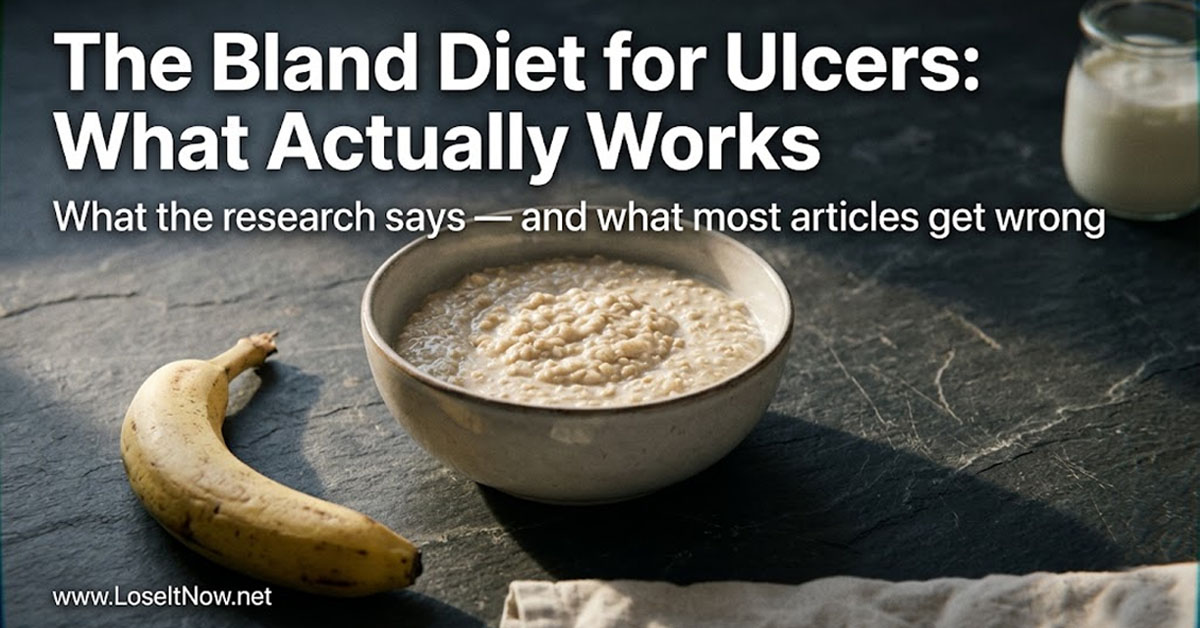

Most pieces on the bland food diet for ulcers open with something like: “A stomach ulcer is a painful sore in the lining of your digestive tract…” and then spend the next 1,200 words telling you to eat oatmeal and avoid peppers. Which is fine, but mostly useless.
Here’s the problem with almost everything written on this topic: it treats diet as the intervention. As if eating rice and boiled chicken is, in itself, going to heal the wound in your stomach wall. It isn’t. The research on this has been pretty clear for decades, and the gap between what gastroenterologists actually know and what gets printed on the internet is embarrassingly wide.
So — what does the bland food diet for ulcers actually accomplish? Does it matter what you eat? Is any of the traditional advice supported by evidence? Yes to the last two, but the answers are more complicated and more interesting than “eat soft foods and rest.”
The Short Answer (Before It Gets Complicated)
Dietary changes can reduce symptom severity during an active ulcer. They can’t treat the underlying cause, and they probably won’t accelerate healing much.
But the longer version matters. Because the wrong approach to diet — including some things still recommended routinely — can actively make things worse. And the things that genuinely help aren’t the things most articles focus on.
What’s Actually Happening in Your Stomach
The peptic ulcer story changed completely in 1982 when Barry Marshall and Robin Warren discovered that Helicobacter pylori — a corkscrew-shaped bacterium — was living in the stomachs of the majority of ulcer patients. Marshall won the Nobel Prize in 2005. Before that, ulcers were thought to be caused primarily by stress, excess acid, and yes, spicy food. Decades of bland diet advice were built on that wrong assumption.
The numbers: roughly 70–90% of duodenal ulcers and around 60–70% of gastric ulcers are associated with H. pylori. Most of the rest? Long-term NSAID use — ibuprofen, aspirin, naproxen, especially taken on an empty stomach. That’s the list. Jalapeños aren’t on it. Black coffee isn’t on it. Stress isn’t on it. Those can aggravate symptoms. They don’t dig the hole.
This matters enormously for the food question because the mechanism of healing is biological, not culinary. If you have an H. pylori-positive ulcer, the first-line treatment is a 10–14 day course of antibiotics plus a proton pump inhibitor. That’s what eradicates the infection. That’s what allows the mucosal lining to regenerate. Food is playing a supporting role — reducing irritation, managing symptoms, keeping nutrition up while the real work happens.
The 2014 review Nutritional Care in Peptic Ulcer (published in Einstein: São Paulo Journal, PMC4743227) states this plainly: H. pylori is the main etiologic factor, and dietotherapy is important but secondary. A 1991 PubMed review of diet and ulcer disease reached the same conclusion even earlier: “there is now little role for dietary therapy” as primary treatment, though diet probably isn’t harmful if used short-term.
The reason that’s buried in footnotes while thousands of “ulcer diet” articles circulate freely is, frankly, that people want dietary answers. Having a list of foods to eat and avoid feels like doing something. I understand the appeal.
The Complication: Where the Popular Answer Breaks Down
The standard advice — eat bland, soft, low-fiber foods; avoid spice and acidity; drink milk — is not as clean as it looks.
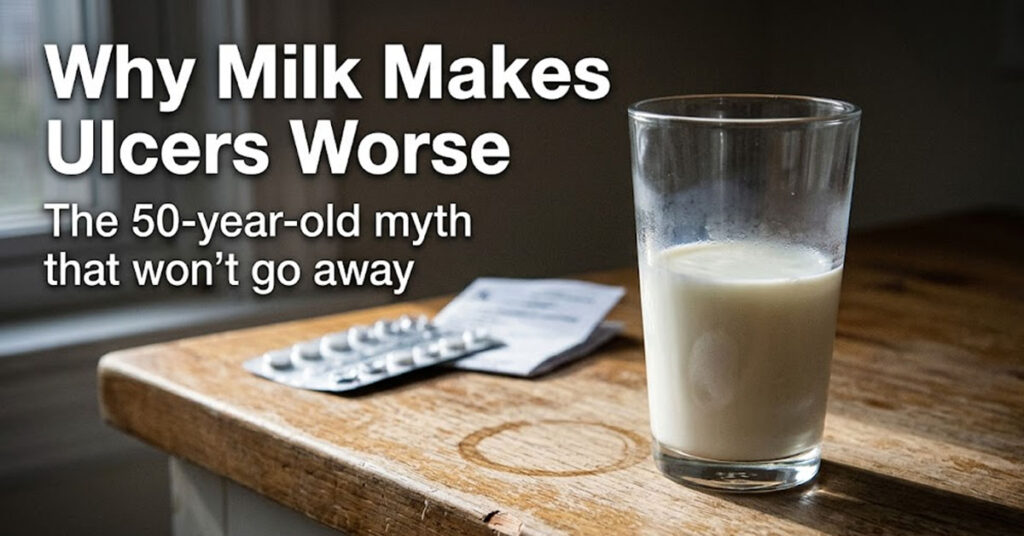
The milk problem. This one’s been known since at least the 1970s and is still widely misunderstood. A landmark PubMed study (PMID 946584) measured the effect of milk on gastric acid secretion in both ulcer patients and healthy controls. The result: 240 ml of whole, low-fat, and nonfat milk all produced a significant increase in acid output — equivalent to roughly 20–35% of maximal stimulated secretion. Why? Because milk contains both protein (casein specifically) and calcium, and both are acid-secretion stimulants.
Milk feels soothing because it buffers acid momentarily. It’s slightly alkaline. For 20–60 minutes, the burning subsides. Then the rebound hits. This is sometimes called the “milk-alkali effect,” and historically it wasn’t just a theoretical concern — the old Sippy regimen (hourly milk plus alkali, once prescribed for ulcers) could cause a now-named syndrome: milk-alkali syndrome, characterized by hypercalcemia, metabolic alkalosis, and acute kidney injury (StatPearls, NCBI Bookshelf NBK557500).
Nobody is recommending the Sippy regimen anymore. But “drink milk for your ulcer” persists in folk medicine and, honestly, in some corners of online health writing. The rebound is real. The research showing it is from 1976. Somehow the advice didn’t follow.
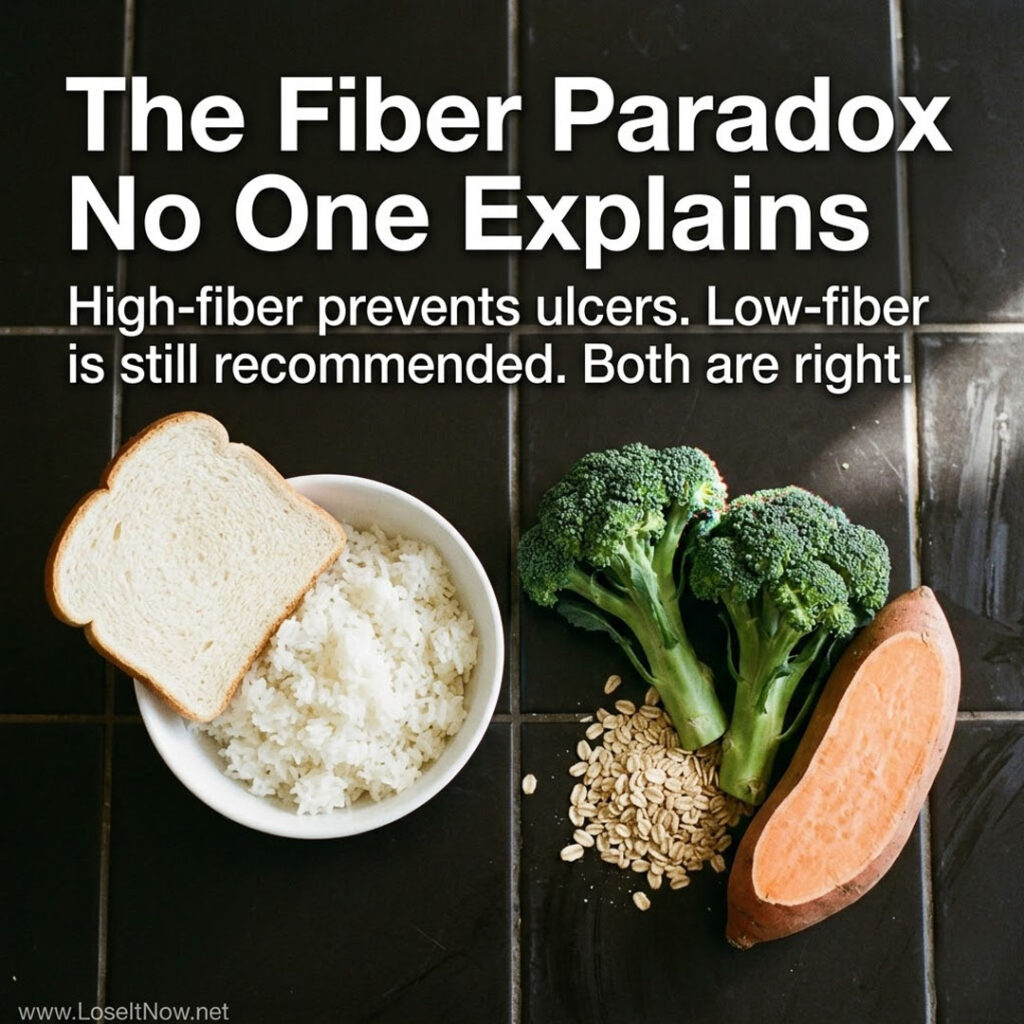
The fiber paradox. This is where things get genuinely interesting, and where almost no popular article bothers to go. A 6-year Harvard cohort study published in the American Journal of Epidemiology (1997) found that men in the highest quintile of dietary fiber intake had a 45% lower risk of developing a duodenal ulcer compared to those in the lowest quintile (RR = 0.55). Soluble fiber was particularly protective (RR = 0.40). Vitamin A was also inversely associated with ulcer risk (54% lower risk in the highest intake group).
And yet — the traditional bland food diet for ulcers is a low-fiber diet. You’re told to eat white rice, white bread, peeled cooked fruit, and to avoid the cruciferous vegetables and whole grains that fiber research identifies as protective.
Here’s the distinction that actually matters: fiber appears to reduce the risk of developing an ulcer, particularly through effects on gastric emptying and mucosal protection. But once an ulcer exists, high-fiber diets don’t appear to significantly accelerate healing. A Scandinavian trial found that wheat bran supplementation had no effect on ulcer recurrence rates compared to controls. So: fiber protects against getting one; it doesn’t cure it once you do. Low-fiber bland diets aren’t necessary for healing, but they may genuinely reduce mechanical irritation during an acute phase.
The spice question. I’ll be honest — this is the one that most surprises people. Spicy food does not cause peptic ulcers. The research on this is consistent enough that it borders on settled. In fact, capsaicin — the active compound in chili peppers — appears in multiple reviews to do the opposite: it inhibits gastric acid secretion, stimulates alkali and mucus secretions, and increases mucosal blood flow, all of which should theoretically help rather than harm the stomach lining (Satyanarayana MN, Critical Reviews in Food Science and Nutrition, 2006; Examine.com meta-analysis of clinical trials, 2024).
Epidemiological data from Singapore found gastric ulcers were three times more common in ethnic Chinese populations than in Malay and Indian populations — groups that consume significantly more chili. A pharmacology review in ScienceDirect (2024) found capsaicin enhanced repair of gastric mucosal damage and provided protection against injury caused by ethanol and aspirin.
That said: spicy food can clearly aggravate symptoms in someone who already has an ulcer. Pain is real even if the mechanism isn’t damage. So “avoid spicy food if it hurts” is reasonable personal guidance. “Spicy food causes or worsens your ulcer biologically” is not supported by the evidence.
Food, Nutrients, and Healing: The Data Table
| Dietary Factor | Effect on Ulcer Risk | Effect on Active Ulcer | Source |
|---|---|---|---|
| High-fiber diet | 45% lower risk (duodenal ulcer) | No significant improvement in healing rate | Harvard cohort (Am J Epidemiol, 1997); Scandinavian J Gastroenterol review |
| Milk | Initial acid buffering | Triggers acid rebound (20–35% of max output) | PubMed PMID 946584 |
| Capsaicin/spicy food | Possibly protective (inhibits acid, boosts mucus) | May worsen symptoms without worsening biology | Crit Rev Food Sci Nutr 2006; Clinical Correlations, 2020 |
| Probiotics (dietary/supplement) | Modest protective effect | Improves H. pylori eradication rates when added to antibiotic therapy | Frontiers in Cell. Inf. Micro. 2023 (91 RCTs, n=13,680) |
| Vitamin A (dietary) | 54% lower duodenal ulcer risk | Limited healing evidence | Harvard cohort (Am J Epidemiol, 1997) |
| Small frequent meals | No advantage over 3 meals/day | May increase acid secretion | Mayo Clinic Diet Manual, PubMed 2072799 |
| NSAIDs | Major risk factor; avoid during recovery | Directly damage mucosal lining | StatPearls NBK538500 |
| Caffeine | Weak association with acid secretion | Aggravates symptoms; avoid during acute phase | PMC dietary review |
Sources: American Journal of Epidemiology 1997, PubMed PMID 946584, Frontiers in Cellular and Infection Microbiology 2023, StatPearls NBK538500, PMC2214597
The Thing Nobody Talks About: The Nutritional Depletion Problem
Here’s the angle I’ve never seen covered in an ulcer diet article, and honestly it should be.
H. pylori infection doesn’t just wound the stomach lining — it actively disrupts nutrient absorption. The Nutrition Guide for Clinicians (Physicians Committee for Responsible Medicine, citing multiple primary sources) notes that H. pylori infection specifically interferes with vitamin C, vitamin A, iron, folate, and vitamin B12 absorption. These deficiencies improve when H. pylori eradication therapy is combined with iron or B12 supplementation — meaning the infection is directly causing the depletion.
Now consider: you’re already malnourished in several key nutrients due to the infection. And you’re being put on a bland food diet that strips out the exact foods — leafy greens, cruciferous vegetables, citrus, legumes, fortified whole grains — that contain those nutrients.
(Which almost nobody mentions, and honestly should be talked about more.)
A typical bland diet during acute ulcer flare: white rice, white toast, boiled chicken, bananas, low-fat yogurt. Not exactly nutrient-dense. Fine for a week. Potentially counterproductive if maintained for months, which some people do, because no one told them when to stop.
StatPearls (NBK538500) flags this directly: prolonged use of a low-residue diet “can lead to nutritional deficiencies” and is “not appropriate for long-term management.” Bland diets are designed as short-term interventions. The problem is that ulcers don’t always heal fast, and patients — often without follow-up guidance — can end up maintaining unnecessary restriction for months.
The practical implication: if you’re on H. pylori treatment, your nutritional rehabilitation matters. Getting iron, B12, folate, and vitamin C back into your diet as quickly as tolerated isn’t optional. It’s part of actual recovery.
What Actually Helps: Specific Guidance
Forget the generic lists. Here’s what the evidence supports in practical terms:
During acute symptomatic phase (active pain, flare):
- Eat three regular-sized meals rather than grazing all day. The “small frequent meals” advice is still repeated constantly. A review cited in PubMed (PMID 2072799) notes that this approach has not been shown more effective than three meals/day and may actually increase total acid secretion. Eat on a normal schedule. Don’t skip meals (an empty stomach can worsen discomfort), but don’t snack constantly either. Though I’ll admit — some people swear the frequent-small-meals approach helps them symptomatically, which the research doesn’t fully explain. Bodies are annoying that way.
- Avoid lying down for 2–3 hours after eating. Gravity matters for keeping gastric contents where they belong. This one is genuinely useful and genuinely ignored.
- Caffeine out, temporarily. It triggers gastrin (the hormone that tells your stomach to ramp up acid production) and loosens the valve between your stomach and esophagus. That’s two bad things at once. Decaf during the acute phase is not optional if you’re waking up at 3am in pain.
- NSAIDs: stop taking them if you possibly can. This is more important than anything you eat. If you have pain and you’re taking ibuprofen for it, you’re adding gasoline. Ask your doctor about acetaminophen instead.
- Alcohol: avoid completely during the acute phase. Alcohol disrupts the mucosal barrier directly.
Foods that genuinely appear useful:
- Cooked oats or whole oat porridge — soluble fiber, easy to digest, doesn’t stimulate excess acid
- Steamed or boiled vegetables (carrots, spinach, courgette/zucchini) — get nutrients in without raw fiber load
- Plain probiotic yogurt — if you tolerate dairy — small amounts with meals (not as acid relief on an empty stomach). The probiotic evidence for H. pylori adjunct treatment is actually solid: a 2023 meta-analysis of 91 RCTs involving 13,680 patients found that adding probiotics to H. pylori eradication therapy improved eradication rates and significantly reduced antibiotic side effects (Frontiers in Cellular and Infection Microbiology, 2023).
- Bananas and cooked apples
- Lean protein. Fish, eggs, skinless chicken. Tissue repair requires protein. Don’t eliminate it to make your diet “gentler.”
- Sweet potatoes — high in vitamin A, and the Harvard cohort study links high vitamin A intake to 54% lower duodenal ulcer risk. (I remember reading this for the first time and thinking: sweet potato is the anti-ulcer food nobody ever mentions. Still true.)
What you don’t need to obsess over:
- Eliminating all “acidic” foods. The stomach’s natural pH is around 1.5–3.5. A tomato’s acidity is nowhere near that. Tomatoes may cause reflux discomfort in some people — that’s individual. They’re not biologically worsening your ulcer.
- Never eating spicy food again. Once the acute phase resolves, there’s no good evidence that moderate chili use damages anything.
- Milk as medicine. A small amount of low-fat dairy with meals is fine if you tolerate it. Do not use it as an antacid. It will backfire in 30–90 minutes.
What’s Missing From the Standard Advice
The research gaps here are real, and worth acknowledging:
We don’t know the optimal dietary fiber strategy during healing. Fiber protects against getting an ulcer. It doesn’t clearly help heal one. But does extremely low fiber delay healing? We don’t know. The studies comparing high vs. low fiber diets during active peptic ulcer are old (mostly 1980s) and underpowered.
Individual variation is enormous and almost unstudied. Some people have dramatic symptom relief on a strict bland diet; others feel no different. The research consistently fails to account for this. Citing population-level data to an individual with a specific presentation is always imprecise.
Psychological function of food rules. Having a list of things to eat and avoid gives people some sense of agency during a frightening, painful, often chronic condition. PubMed 2072799 actually notes this, stating that bland diets “may have some psychological benefit.” That’s underrecognized and, I’d argue, real. The problem is when the psychological benefit turns into indefinite unnecessary restriction.
The role of diet post-eradication. What should you eat after H. pylori treatment concludes? Almost nothing has been written on this that’s evidence-based. The microbiome changes substantially after a 10-14 day antibiotic course. How to support recovery of gut flora afterward — including through diet — is genuinely underresearched and underreported.
My Take
I’ve read a lot of research on this topic and talked to a fair number of people managing active ulcers. A pattern shows up consistently: the people who do well are the ones who understand what the diet is actually for. Symptom management during acute flare, temporary reduction in mechanical and chemical irritation, maintenance of adequate nutrition while the medication does its job. That’s it.
The ones who struggle are the ones given a food list without context — who believe that if they just eat bland enough food for long enough, the ulcer will heal. Some of them white-knuckle a restrictive diet for months, become deficient in iron or B12, feel terrible, and assume they’re not being strict enough. Meanwhile the underlying H. pylori was never fully eradicated, or they’re still taking ibuprofen daily for their bad knee.
I’ll go further: the bland food diet as traditionally described — low fiber, avoid most vegetables, no spice, drink milk — is not supported by modern research as a healing protocol. Parts of it make sense for short-term symptom management. The fiber restriction, the milk, the small-frequent-meal advice, the blanket avoidance of vegetables because they’re “too gassy” — those recommendations are either outdated, mildly counterproductive, or they exist because they were written before we understood the actual cause of most ulcers.
That said, I’m not suggesting people with active, symptomatic ulcers eat however they like. Individual tolerance is real. If something makes you hurt, stop eating it for now. That’s not the same as saying it’s causing damage.
The honest version of ulcer dietary advice is: follow medical treatment as prescribed, eat a reasonably gentle, nutritious diet during the acute phase, don’t restrict so severely that you become malnourished, and expect to return to a normal varied diet once treatment is complete. It’s less satisfying than a food list. It’s more accurate.
The Honest Summary
A bland food diet for ulcers is a reasonable short-term tool for symptom management. It is not a treatment. The underlying cause — usually H. pylori or NSAID damage — requires medical intervention that no amount of oatmeal replaces.
The most evidence-supported dietary moves during an ulcer: avoid milk as an antacid, stop NSAIDs, limit caffeine and alcohol during the acute phase, eat enough protein and vitamin A, and consider probiotic support if you’re on antibiotics for H. pylori. None of that is conventional “bland diet” advice, but it’s what the research actually points toward.
What we still don’t know: optimal fiber levels during active healing, ideal diet post-eradication, and why individual symptom response to food varies so widely. The research on diet and ulcers is older and thinner than people assume. Some of the most-cited studies are from the 1980s and 90s.
Eat gently. Treat the cause. Don’t maintain unnecessary restriction longer than the acute phase demands.
That’s about as honest as this topic gets.
Disclaimer: This article is for informational purposes only and does not constitute medical advice. Peptic ulcer disease requires diagnosis and treatment by a qualified healthcare provider. Do not use dietary changes as a substitute for prescribed medical treatment. If you’re experiencing symptoms of a stomach ulcer — particularly black or bloody stools, severe abdominal pain, or vomiting blood — seek medical attention immediately.